Anchor Rode and Chain Buying Guide: How Much Chain and Rope You Need

Quick answer: Most recreational boats should use a rope-chain rode: a length of galvanized chain at the anchor (a common rule is about 1 foot of chain per foot of boat length) connected to nylon line. Carry enough total rode for about 7 to 1 scope in the deepest water you anchor in, sized at roughly 1/8 inch of nylon diameter per 9 feet of boat length. Larger cruisers with windlasses often go all chain. Match chain size and grade to your windlass gypsy if you have one.
Your anchor is only as good as the rode attached to it. The rode keeps the pull on the anchor low and level so it digs in, absorbs shock when waves and wind hit the boat, and has to survive chafe on the bottom and at the bow. This guide explains chain versus rope, how much of each you need, how to size it, and how to connect it all.
Step 1: Rope-chain or all chain?
| Rode type | Pros | Cons | Best for |
|---|---|---|---|
| Rope-chain combo | Lighter, stretchy nylon absorbs shock, cheaper | Needs more scope, rope can chafe | Most boats under about 35 ft |
| All chain | Chafe-proof, holds with less scope, self-stowing in a windlass | Heavy, needs a windlass, needs a snubber | Larger cruisers, coral or rocky bottoms |
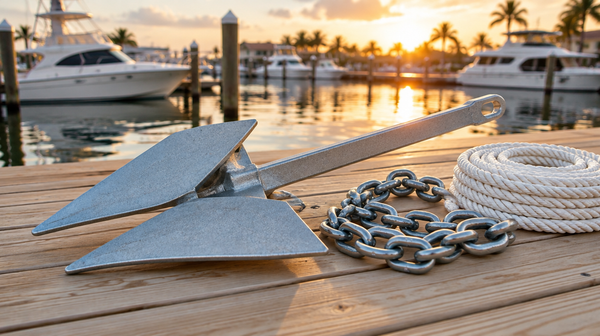
The chain at the anchor matters even on a rope rode. Its weight keeps the pull angle low so the anchor sets and stays set, and it protects the line from chafe on the bottom.
Step 2: How much chain?
A common rule is about 1 foot of chain for every foot of boat length, with 6 to 8 feet as a bare minimum on small boats. More chain improves holding and setting, especially in wind and current.
Step 3: Size the nylon line
| Boat length | Typical nylon diameter |
|---|---|
| Up to about 18 ft | 1/4 in |
| About 18 to 27 ft | 3/8 in |
| About 27 to 36 ft | 1/2 in |
| About 36 to 45 ft | 5/8 in |
Use nylon, not polypropylene. Nylon stretches to absorb shock loads and is strong and abrasion resistant. Polypropylene floats, which can foul props, and degrades in UV. Three-strand nylon is easy to splice. Braided (brait) nylon flakes cleanly and feeds smoothly through windlass gypsies.
Step 4: Carry enough for proper scope
Scope is the ratio of rode length to the depth of water plus the height of the bow above the water.
- Rope-chain rode: about 7 to 1 for good holding, 5 to 1 minimum in calm conditions.
- All chain: about 3 to 1 to 5 to 1, more in bad weather.
Example: anchoring in 15 feet of water with a bow 3 feet high is 18 feet. At 7 to 1 you need about 126 feet of rode. Carry enough for the deepest spot you normally anchor, plus a spare anchor and rode for emergencies.
Step 5: Connect it correctly
- Rope to chain: a back splice or a thimble with an eye splice. A splice runs through a windlass, a thimble and shackle does not.
- Chain to anchor: a galvanized or stainless shackle sized to the chain, or an anchor swivel that keeps the anchor oriented on the roller.
- Seize every shackle pin with stainless or monel wire so it can't back out.
- Bitter end: tie the inboard end to a strong point in the locker so you don't lose the whole rode.
Step 6: Match your windlass
If you have a windlass, the chain size and grade (G4 or BBB) and rope diameter must match the gypsy. See our windlass buying guide. Premade rodes from windlass makers are spliced to run through their gypsies.
Common mistakes to avoid
- Too little rode for the depth. Short scope is the top reason anchors drag. Carry enough for 7 to 1 in your usual spots.
- Polypropylene anchor line. It floats toward your prop, has little stretch and breaks down in sun. Use nylon.
- No chain at all. Rope straight to the anchor lifts the shank and pulls the anchor out, and the line chafes on the bottom.
- Unseized shackle pins. Vibration and movement back them out. Seize them with wire.
- Forgetting the bitter end. Tie it off in the locker, or one day the whole rode follows the anchor over the side.
- Never inspecting it. Check chain for rust and worn links and rope for chafe and stiffness every season, and turn the rode end for end to spread the wear.
Our picks
All in stock at Boat Supplies Direct.
Small cruisers and center consoles
Maxwell Rode, 15 ft of 1/4 in chain to 150 ft of 1/2 in nylon brait or the Quick Rode, 15 ft of 7mm chain and 200 ft of 1/2 in rope.
Mid-size cruisers
Maxwell Rode, 15 ft of 5/16 in chain to 150 ft of 5/8 in nylon or the longer 18 ft chain and 200 ft line version.
Deeper water
Quick Rode, 25 ft of 8mm chain and 300 ft of 9/16 in rope.
Connections
Quick SH8 Stainless Anchor Swivel or the Maxwell Anchor Swivel Shackle, 6 to 8mm.
Easy retrieval without a windlass
Attwood Anchor Lift System, a buoy and ring that floats the anchor up as you motor forward.
Shop all anchor rope and chain →
Frequently Asked Questions
How much chain should I have on my anchor?
A common rule is about 1 foot of chain per foot of boat length, with at least 6 to 8 feet on small boats. More chain improves setting and holding.
How much anchor rope do I need?
Enough for about 7 to 1 scope in the deepest water you anchor in, measured from the bow height plus depth. Many boats carry 150 to 300 feet.
What size anchor line do I need for my boat?
A common rule is about 1/8 inch of nylon diameter per 9 feet of boat length, so 3/8 inch for most boats around 20 to 27 feet.
What type of rope is best for an anchor line?
Nylon. It stretches to absorb shock, resists abrasion and is strong. Avoid polypropylene for anchoring.
What does 7 to 1 scope mean?
7 feet of rode for every foot of water depth plus bow height. In 15 feet of water with a 3 foot bow, that is about 126 feet of rode.
Do I need a swivel on my anchor?
A swivel helps the anchor come up the right way on the bow roller and reduces twist. Use a quality swivel rated for your chain and seize the pin.
This guide is general information. Anchoring needs vary with boat weight, bottom type and conditions, so follow your anchor and windlass manufacturers' recommendations.