Macerator Pump Buying Guide: Flow, Legal Discharge and Install Tips

Quick answer: Most recreational boats are well served by a 12V macerator pump in the 12 to 13 GPM range, which empties a 30 gallon holding tank in roughly 3 to 4 minutes. Match the voltage to your boat, mount the pump below the tank outlet so it stays flooded, and shut it off the moment the tank is empty, because running dry is the number one macerator killer. Only discharge untreated waste where it is legal: more than 3 nautical miles offshore and never in a No Discharge Zone.
A macerator pump grinds holding tank waste into a slurry and pushes it overboard through a dedicated thru-hull. It is the piece of the sanitation system that lets offshore and coastal cruisers empty the tank without hunting for a pump-out station. Pick the wrong one, or install it badly, and you get clogs, burned-out motors and a very unpleasant repair. This guide covers flow, legality, mounting, plumbing, wiring and the habits that make a macerator last.
Step 1: Know when a macerator is legal to use
Federal rules prohibit discharging untreated sewage within 3 nautical miles of the US coast and in inland waters such as lakes and rivers. In a designated No Discharge Zone, no sewage may go overboard at all, treated or not. Inside these areas the Y-valve or seacock that feeds the macerator must be secured closed, for example with a padlock, a wire tie or the handle removed. A macerator is a tool for offshore use; inside the 3 mile line, the holding tank goes to a pump-out.
Step 2: Size the pump by tank volume and time
Most marine macerators move 11 to 13 GPM at low head. Real flow drops with discharge height and hose length, so plan on somewhat less than the rated number.
| Holding tank size | Approximate time to empty at 12 GPM | Typical boat |
|---|---|---|
| 10 to 20 gallons | 1 to 2 minutes | Center console or walkaround with a small head |
| 20 to 30 gallons | 2 to 3 minutes | Express cruiser, small sailboat |
| 30 to 50 gallons | 3 to 5 minutes | Cruising sailboat, 30 to 40 ft cruiser |
| 50 gallons and up | 5 minutes or more | Larger yachts, often 24V systems |
Faster is not always better. A standard 12 to 13 GPM unit is plenty for most tanks; buy for reliability and serviceability rather than raw flow.
Step 3: Match voltage and duty
- 12V covers the majority of boats. Larger yachts with 24V house systems should use a 24V version, which draws half the current for the same work.
- 115V AC macerators exist for boats with generators or dock power and are typically used on larger yachts.
- A macerator is for black water discharge only. Do not use it as a bilge pump, washdown pump or general transfer pump. For grey water from a shower sump, use a dedicated grey waste pump.
Step 4: Mount and plumb it correctly
- Mount below the tank outlet whenever possible so the pump stays flooded and primes instantly. Self-priming models can lift a short distance, but gravity feed is always easier on the impeller and motor.
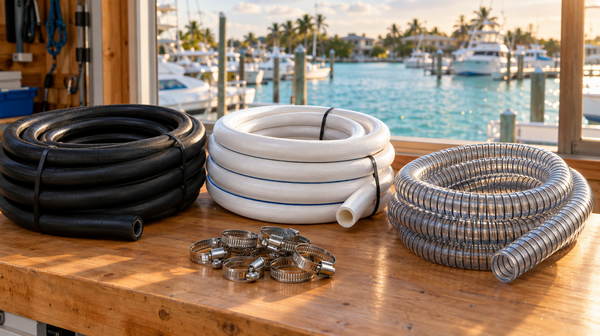
- Use sanitation-rated hose. Most macerators take a 1-1/2 inch inlet from the tank and a smaller discharge, commonly 3/4 or 1 inch. Use smooth-bore, odor-resistant sanitation hose, never bilge or water hose.
- Keep the inlet run short with gentle bends. Every elbow is a place for solids to collect.
- Add a vented loop on the discharge when the thru-hull is near or below the waterline to prevent siphoning seawater back into the system.
- Dedicated seacock. The discharge thru-hull should have its own seacock, closed whenever you are not pumping. Our thru-hull and seacock guide covers materials and installation.
- Double-clamp every sanitation connection with all-stainless hose clamps.
Step 5: Wire it safely
Macerators draw significant current at startup, especially if the blades are fouled. Use tinned marine wire sized for the pump's amp draw and the round-trip run length, fuse it at the source per the manufacturer's rating, and use a momentary or timed switch so the pump cannot be left running unattended. A smart control that shuts the pump off automatically protects against dry running. See our fuse and breaker guide for protection basics.
Step 6: Protect it from running dry and clogging
- Listen to the pump. The sound changes when the tank is empty; switch off immediately.
- After pumping offshore, flush a few gallons of clean water through the head and into the tank, then pump again to clear the chopper and hose.
- Keep wipes, paper towels and feminine products out of the head. Use marine or quick-dissolve toilet paper.
- Carry a service kit with a spare impeller or chopper plate, especially for long passages.
Common macerator pump mistakes
- Running the pump dry for minutes after the tank is empty, which overheats the impeller.
- Using the wrong hose, which permeates odor and collects solids.
- Leaving the Y-valve open in a No Discharge Zone or inside 3 nautical miles.
- Mounting the pump high above the tank so it has to struggle to prime every time.
- Undersized wire that drops voltage and stalls the motor under load.
Our picks for macerator pumps
All in stock at Boat Supplies Direct.
Most popular 12V macerators
Jabsco Sealed Macerator Self-Priming Pump 12V is the long-running standard that fits countless installs, or the Shurflo Macerator Pump 12V 13 GPM, a proven alternative with a 13 GPM rating.
Alternate port layouts
Shurflo Macerator with 180 Degree Port for straight-through plumbing, or the Commodore 12 GPM Macerator Pump 12V.
24V and AC systems
Jabsco Sealed Macerator 24V for larger yachts, or the Jabsco Macerator Pump 115V for AC installs.
Spares and plumbing
Jabsco Service Kit for 18590 Series, Raritan SANI/FLEX 1.5 in Odor Shield Hose, and the Jabsco 3/4 in Vented Loop for the discharge line.
Buying parts often? Get Dock Pass.
Free shipping on every order, 5% off eligible products and 60-day returns for $49 a year. See how Dock Pass works.
Frequently Asked Questions
What does a macerator pump do on a boat?
It grinds holding tank waste into a fine slurry and pumps it overboard through a thru-hull. It is used to empty the tank offshore where discharge of untreated waste is legal.
Where is it legal to use a macerator pump?
In US waters, only beyond 3 nautical miles from shore and never in a No Discharge Zone. Inland lakes and rivers are generally off limits for untreated discharge.
How long should a macerator pump run?
Only until the tank is empty. At 12 GPM a 30 gallon tank takes roughly 3 minutes; switch off as soon as the pump note changes to avoid running dry.
Why does my macerator pump hum but not pump?
Usually a jammed chopper or worn impeller, often from wipes or paper towels, or low voltage from undersized wiring. Clear the blockage and check the impeller before replacing the pump.
Can a macerator pump be mounted above the holding tank?
Self-priming models can lift a short distance, but mounting below the tank outlet is strongly preferred. A flooded pump primes instantly and lasts longer.
What size hose does a macerator pump use?
Most take a 1-1/2 inch sanitation hose on the inlet and a 3/4 or 1 inch sanitation hose on the discharge. Always confirm port sizes for your model.
This guide is general information. Follow US Coast Guard and EPA marine sanitation regulations, state and local No Discharge Zone rules, your pump manufacturer's instructions and ABYC standards, and use a qualified marine technician for plumbing and electrical work.