Mercury Outboard Maintenance: What to Replace and When

Quick answer: Most modern Mercury FourStroke outboards follow a simple rhythm: a break-in check around the first 20 hours, then engine oil and filter, gear lube, anodes, the water separating fuel filter and a full grease job every 100 hours or once a year, whichever comes first. The water pump impeller and spark plugs are commonly due around 300 hours or 3 years. Flush after every saltwater or brackish run. Your owner's manual has the exact intervals and part numbers for your model, so check it before you buy parts.
Mercury outboards are built to run hard for a long time, but only if the small stuff gets done on schedule. Most expensive failures, like a cooked powerhead or a seized lower unit, start with a skipped impeller or a gear case that was never checked. This guide breaks Mercury outboard maintenance into what to replace and when, what you can do in your driveway, and which parts to keep on the shelf.
Step 1: Know your engine and pull up the right schedule
Mercury builds several engine families, and the service list changes with each one. Before you order anything, find the serial number on the swivel bracket or the tag on the engine and confirm exactly what you have.
- FourStroke (2.5 to 150 hp and V6/V8 models): engine oil and filter changes, gear lube, fuel filters, anodes, impeller, spark plugs and thermostat.
- Verado (supercharged and V8/V10/V12): similar list to FourStroke, plus model-specific items like belts. Verado service is more involved, and many owners leave the major items to a dealer.
- Pro XS and SeaPro: follow the FourStroke or OptiMax schedule for the base engine. SeaPro commercial models often have shorter intervals.
- OptiMax and older 2-strokes: no crankcase oil change, but you still need gear lube, fuel filters, anodes, the impeller, plugs and a steady supply of the correct 2-stroke oil.
The intervals in this guide are typical for recreational use. If you run in saltwater, troll for long hours, idle a lot or run hard at wide open throttle, Mercury generally calls that severe service and you should shorten the intervals.
Step 2: Use this Mercury maintenance timeline
| When | What to do |
|---|---|
| After every use | Flush with fresh water (always after salt or brackish water), check the telltale stream, look for fuel leaks, rinse the exterior |
| First 20 hours (break-in) | Change engine oil and filter on FourStroke models, check gear lube, inspect fasteners and the prop |
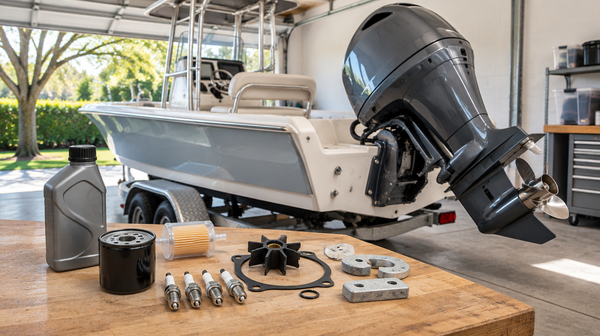
| Every 100 hours or yearly | Engine oil and filter, gear lube, water separating fuel filter, inspect inline filter, inspect or replace anodes, grease all lube points, check battery connections, check prop and prop shaft splines |
| Every 300 hours or 3 years | Water pump impeller and housing kit, spark plugs, thermostat inspection, more thorough fuel system inspection |
| End of season | Stabilize fuel, fog or follow the EFI storage procedure, change oil and gear lube, store fully trimmed down so water drains |
If the boat only runs 30 hours a year, the calendar wins.
Step 3: Engine oil, gear lube and grease
These three fluids cover most of what keeps a Mercury healthy.
- Engine oil and filter (FourStroke and Verado): use the oil grade and filter listed for your model. Many FourStrokes call for a 25W-40 or 10W-30 marine 4-stroke oil, but this varies, so confirm it in the manual. Change it warm, and replace the filter every time.
- Gear lube: drain from the bottom plug with the vent plug removed, then fill from the bottom until it comes out the top vent. Look at what drains out. Milky or gray lube means water is getting past a seal. Metal flakes or a burnt smell mean the gear case needs a closer look before your next trip. Always replace the plug gaskets.
- Grease points: the swivel bracket, tilt tube, steering cable end, trim pivots and prop shaft splines all need marine grease. Pull the prop at every service, clean the shaft, check for fishing line wrapped behind the prop (it can cut the seal), grease the splines and reinstall with the correct hardware.
Step 4: Fuel filters and fuel system parts
Ethanol blended gas attracts water, and water is hard on fuel injection. Most Mercury outboards have an on-engine fuel filter, and almost every boat benefits from a boat-mounted water separating filter between the tank and the engine.
- Water separating filter: replace the element every 100 hours or once a year. If you see water in the bowl or the engine stumbles, change it sooner.
- Inline filter for portable tanks: small boats running a portable tank should have one in the 3/8 inch fuel line.
- Fuel line and primer bulb: a cracked, soft or collapsing primer bulb lets in air and starves the engine. Replace the whole line assembly if it is old or hard.
- Stabilizer: treat fuel any time it will sit for more than a few weeks, and always before winter storage.
For filter micron ratings and how to plumb a separator, see our fuel filter and water separator guide. For choosing a stabilizer or ethanol treatment, read our marine fuel additive guide.
Step 5: Cooling system and anodes
The impeller in the lower unit water pump is the part most likely to leave you with an overheating engine. The rubber vanes take a set, crack and harden with age, even if the engine sits.
- Impeller: plan on a replacement around every 300 hours or 3 years, or sooner if you run in sand, silt or shallow water. A weak telltale or a rising temperature reading is your warning. Always buy the kit matched to your engine serial number, and replace the wear plate and gaskets in the kit at the same time.
- Thermostat: a stuck thermostat causes overheating or an engine that never warms up. Inspect it when you do the impeller.
- Anodes: replace any anode that is about half gone. Use aluminum anodes in saltwater and brackish water, and aluminum or magnesium in freshwater, depending on what your manual and the anode maker specify. Never paint an anode.
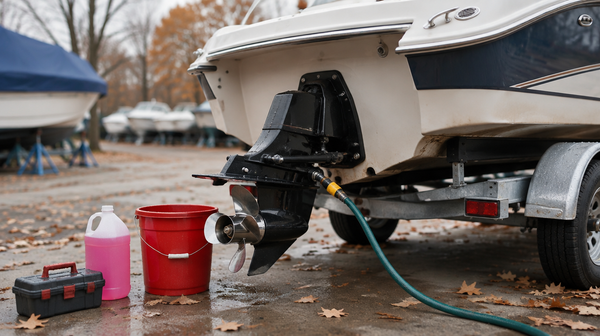
- Flushing: a flush port quick connect lets you flush with a garden hose without muffs, with the engine off on most models. Follow the flushing instructions for your engine.
Our water pump impeller guide covers signs of a failing pump, and the marine anode guide explains zinc vs aluminum vs magnesium.
Step 6: Electrical parts and seasonal layup
Corroded connections cause more no-start calls than failed parts. Clean battery terminals, check the cables at the starter, and coat exposed connections with a dielectric or anti-corrosion gel. If your engine cranks slowly with a good battery, a starter solenoid or the starter itself may be next.
Spark plugs are cheap insurance. Inspect them at the annual service and replace them on the schedule in your manual. Use only the plug type and gap listed for your model.
When the season ends, do your annual service before storage so fresh oil sits in the engine all winter. Treat the fuel, run the engine to get treated fuel into the system, fog if your manual calls for it, store the motor trimmed fully down so water drains from the powerhead, and pull the battery or keep it on a maintainer. Our outboard winterizing guide walks through it step by step, and the boat winterizing checklist covers the rest of the boat.
Our picks for Mercury outboard maintenance
All in stock at Boat Supplies Direct. Confirm fit with your engine serial number before you order.
Fuel filters and fuel line
Attwood Universal Fuel/Water Separator Kit w/Bracket for adding a water separating filter, and the Attwood Fuel/Water Separator replacement element for annual changes. Portable tank boats should look at the Attwood Outboard Fuel Filter for 3/8 inch lines and the Attwood Mercury Fuel Line Kit with Fuel Demand Valve, a 6 foot, 3/8 inch line with Mercury fittings.
Anodes
Performance Metals Mercury Outboard Power Trim Anode (Aluminum) for the trim cylinder, and the Performance Metals Mercury Verado 4 / OptiMax Complete Anode Kit (Aluminum) to replace every anode on those engines in one order.
Flushing
Flushmaster Flush Port Quick Connect for Mercury Outboards makes hooking up a hose fast after every run. The T-H Marine Quick Flush Fitting Kit for Mercury and Yamaha is another good option.
Fuel treatment and storage
STA-BIL Fuel Stabilizer, 32 oz for off-season fuel, and STA-BIL Fogging Oil, 12 oz for engines whose manual calls for fogging before storage.
Shop all Mercury outboard parts →
Buying parts often? Get Dock Pass.
Free shipping on every order, 5% off eligible products and 60-day returns for $49 a year. See how Dock Pass works.
Frequently Asked Questions
How often should I service my Mercury outboard?
For most recreational Mercury FourStrokes, the routine service is every 100 hours or once a year, whichever comes first. Bigger items like the water pump impeller and spark plugs are often due around 300 hours or 3 years. Check your owner's manual for your exact model.
How often should I replace the water pump impeller on a Mercury?
A common interval is every 300 hours or 3 years, but replace it sooner if you run in sandy or silty water, see a weak telltale stream, or notice rising engine temperature.
Do I need to change the oil on a Mercury 2-stroke?
No. OptiMax and other 2-stroke Mercury engines have no crankcase oil to change, but they burn injected 2-stroke oil, so keep the reservoir full with the type Mercury specifies. Gear lube, filters, anodes and the impeller still need regular service.
What does milky gear lube mean?
Milky or gray gear lube means water is getting into the gear case, usually past a prop shaft seal, drive shaft seal or a drain plug gasket. Have the lower unit pressure tested and resealed before running it much more.
Should I use zinc or aluminum anodes on my Mercury?
Aluminum anodes work well in saltwater and brackish water and are what many Mercury outboards ship with. In freshwater, aluminum or magnesium is typical. Follow your manual and match the anode to where you boat most.
Can I do my own Mercury maintenance without voiding the warranty?
Routine maintenance can generally be done by the owner, but keep receipts and records, use parts and fluids that meet Mercury specifications, and read your warranty terms. Some warranty and extended coverage programs require dealer service.
This guide is general information, not a substitute for your engine's service manual. Maintenance intervals, fluid types, torque values and part numbers vary by model and serial number. Always follow Mercury Marine's published specifications for your engine, and see a qualified marine technician if you are unsure about any repair.