Yamaha Outboard Service Parts by Horsepower: What to Replace and When

Quick answer: Most Yamaha four-stroke outboards get a break-in check around the first 20 hours, then engine oil and filter, gear oil, anodes, the boat-mounted water separating fuel filter and a full grease job every 100 hours or once a year, whichever comes first. The water pump impeller, spark plugs and thermostat come up on a longer cycle, often in the 200 to 300 hour or 2 to 3 year range depending on the model. What changes by horsepower is which parts your engine has and how big they are. Check your owner's manual for exact intervals and part numbers before you order.
Yamaha builds outboards from a 2.5 hp kicker to a 450 hp V8, and the service parts list grows with the engine. A small portable might need oil, gear oil, a plug and an impeller. A V6 on a center console adds a spin-on filter, multiple fuel filters, a full anode kit and more grease points. This guide breaks Yamaha service parts down by horsepower range, gives you a simple timeline, and lists the parts worth keeping on the shelf.
Step 1: Find your exact model before buying anything
Yamaha part numbers change between model years and even within the same horsepower. Find the model and serial number on the label on the swivel or clamp bracket, then look up parts by that number, not by horsepower alone.
- Model code: something like F150XB or F250UCA. The letters after the horsepower tell you shaft length, rotation and generation.
- Rotation: counter-rotating engines (often marked with an L) on twin installs can use different lower unit parts and anode kits.
- Two-stroke vs four-stroke: older 2-strokes and HPDI models have no crankcase oil change but still need gear oil, filters, anodes, impellers and plugs.
The intervals in this guide are typical for recreational use. Saltwater, long trolling hours, lots of idling or hard wide open throttle running all count as heavier duty, so shorten your intervals if that is how you boat.
Step 2: Know what changes by horsepower
| Horsepower range | Typical service parts | Things to watch |
|---|---|---|
| Portable (F2.5 to F25) | Engine oil, gear oil, spark plug(s), impeller kit, fuel line and primer bulb, inline fuel filter, anode | Carbureted models are sensitive to old or ethanol fuel. Some of the smallest models have no spin-on oil filter. |
| Midrange (F30 to F130) | Oil and spin-on filter, gear oil, on-engine and boat-mounted fuel filters, plugs, impeller kit, anodes, thermostat | Many are fuel injected, so clean fuel matters. Some models use a timing belt that needs periodic inspection. |
| Big inline and V6 (F150 to F350) | Oil and filter, gear oil, fuel filters, plugs, impeller kit, full anode kit, thermostats, grease points | Larger oil capacity and more anodes. Anode kits vary by horsepower range and rotation. |
| XTO V8 (F350 to F450) | Same core list in larger sizes, plus model-specific items | Direct injection and complex systems. Many owners leave major service to a Yamaha dealer. |
Step 3: Use this Yamaha service timeline
| When | What to do |
|---|---|
| After every use | Flush with fresh water (always after salt or brackish water), check the telltale stream, look for fuel or oil leaks, rinse the cowling |
| First 20 hours (break-in) | Change engine oil and filter, check gear oil, inspect fasteners, prop and fuel lines |
| Every 100 hours or yearly | Engine oil and filter, gear oil, boat-mounted water separating filter, inspect on-engine fuel filter, inspect or replace anodes, grease all lube points, inspect plugs, check battery cables, pull and grease the prop |
| Every 200 to 300 hours or 2 to 3 years | Water pump impeller kit, spark plugs, thermostat inspection, timing belt inspection where equipped (exact interval per manual) |
| End of season | Stabilize fuel, run treated fuel through the engine, change oil and gear oil, follow Yamaha's storage procedure, store trimmed fully down |
If your boat only runs 40 hours a year, the calendar interval comes first.
Step 4: Oil, gear oil and grease
- Engine oil and filter: many Yamaha F-series engines call for a 10W-30 FC-W rated marine four-stroke oil, but some models specify a different grade. Use what your manual lists, change it warm, and replace the filter every time on engines that have one.
- Gear oil: drain from the bottom plug with the top vent plug removed, then pump new gear oil in from the bottom until it comes out the vent. Milky or gray oil means water is getting in. Metal flakes or a burnt smell mean the lower unit needs a closer look. Replace the drain and vent plug gaskets every time.
- Grease: swivel bracket, tilt tube, steering pivot, trim pivots and prop shaft splines all need marine grease. When the prop comes off, check for fishing line wrapped behind it, since line can cut the prop shaft seal.
Step 5: Fuel filters, fuel line and stabilizer
Yamaha puts a lot of weight on clean, dry fuel, especially for fuel injected engines. Yamaha commonly recommends a boat-mounted water separating filter in addition to the filter on the engine. Check your manual for the micron rating it specifies and match your filter to it.
- Boat-mounted water separator: replace the element every 100 hours or yearly, and sooner if you see water in the bowl or the engine stumbles.
- On-engine filter: inspect at each service and replace on the schedule in your manual.
- Portable tanks: on small Yamahas, an inline filter and a fresh fuel line with a good primer bulb fix a lot of hard starting. A soft, cracked or collapsing bulb lets in air.
- Stabilizer: treat fuel any time it will sit more than a few weeks.
Our fuel filter and water separator guide covers micron ratings and plumbing, and the marine fuel additive guide explains stabilizers and ethanol treatments.
Step 6: Cooling system and anodes
- Impeller: the rubber vanes harden and crack with age even when the engine sits. Replace the kit on your manual's schedule, sooner if you run in sand or silt, see a weak telltale, or notice the temperature climbing. Buy the kit matched to your model and replace the gaskets and wear parts included.
- Thermostat: a stuck thermostat causes overheating or an engine that never warms up. Inspect it when you do the impeller.
- Anodes: a mid to large Yamaha has several, on the bracket, trim tab, lower unit and sometimes inside the powerhead. Replace any anode that is about half gone. Match the metal to your water and your manual's guidance, and never paint an anode.
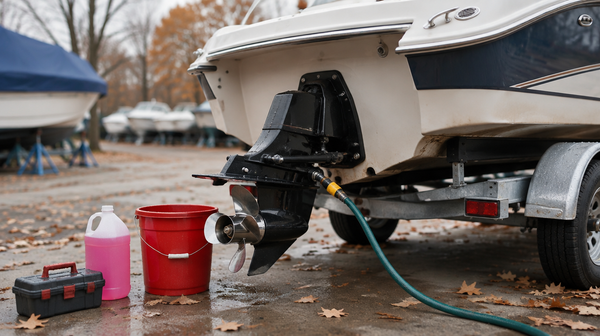
- Flushing: a quick connect on the flush port lets you hook up a garden hose in seconds after every run. Follow the flushing instructions for your model.
See our water pump impeller guide for warning signs and the marine anode guide for zinc vs aluminum vs magnesium. Running a Mercury too? Our Mercury outboard maintenance guide covers that side. With winter here, the outboard winterizing guide and boat winterizing checklist walk through layup step by step.
Our picks for Yamaha outboard service
All in stock at Boat Supplies Direct. Confirm fit with your model and serial number before you order.
Anode kits by horsepower
Tecnoseal Anode Kit for Yamaha 150-200 HP (Aluminum) for standard rotation engines in that range. For 200 to 250 hp, choose the Tecnoseal Anode Kit with Hardware for Yamaha 200-250 HP (Aluminum) or the Tecnoseal Anode Kit for Yamaha 200-250 HP (Zinc). High-performance 200 to 300 hp models use the Tecnoseal Hi-Performance Anode Kit with Hardware (Zinc).
Bracket anode
Tecnoseal Transom Bar Anode for Yamaha (Aluminum) replaces the bar anode on the engine bracket, one of the first to wear.
Flushing
T-H Marine Quick Flush Fitting Kit for Mercury and Yamaha makes the after-run freshwater flush a one minute job.
Fuel system
Attwood Universal Fuel/Water Separator Kit with Bracket for adding a boat-mounted separator, and the Attwood Fuel/Water Separator replacement element for yearly changes. Portable tank owners should look at the Attwood Yamaha Fuel Line Kit, 6 ft x 3/8 inch.
Storage
STA-BIL Fuel Stabilizer, 32 oz keeps fuel fresh through the off season.
Shop all Yamaha outboard parts →
Buying parts often? Get Dock Pass.
Free shipping on every order, 5% off eligible products and 60-day returns for $49 a year. See how Dock Pass works.
Frequently Asked Questions
How often should I service my Yamaha outboard?
For most recreational Yamaha four-strokes, routine service is every 100 hours or once a year, whichever comes first. Longer interval items like the impeller and spark plugs are often due somewhere in the 200 to 300 hour or 2 to 3 year range. Your owner's manual has the exact schedule.
What oil does a Yamaha four-stroke outboard use?
Many Yamaha F-series engines use a 10W-30 FC-W rated marine four-stroke oil, but some models call for a different grade. Use the oil and quantity listed in your manual.
How often should I replace the water pump impeller on a Yamaha?
Follow the interval in your manual, commonly in the 2 to 3 year range. Replace it sooner if you run in sandy or shallow water, the telltale stream weakens, or the engine runs hotter than normal.
Do I need a separate fuel water separator on a Yamaha?
Yamaha commonly recommends a boat-mounted water separating filter in addition to the filter on the engine. It catches water and debris before they reach the fuel system. Match the micron rating to what your manual specifies.
Are Yamaha anode kits different for counter-rotating engines?
Often, yes. Left hand rotation engines can use different lower unit parts and anode kits, so order by model code and rotation, not horsepower alone.
Can I service my own Yamaha without voiding the warranty?
Routine maintenance can generally be done by the owner if you use parts and fluids that meet Yamaha specifications and keep receipts and records. Read your warranty terms, since some coverage programs require dealer service.
This guide is general information, not a substitute for your engine's service manual. Maintenance intervals, fluid types, torque values and part numbers vary by model and serial number. Always follow Yamaha's published specifications for your engine, and see a qualified marine technician if you are unsure about any repair.